A tracker that asks the same question in week nine has not been paying attention.
Week one Snapkin asks a lot, because it has never met your kitchen. It does not know your skyr is the 0% one, that you tare the scale, that your chicken breasts run about 180 grams, ... Every time you tell it something it writes one sentence down, and stops asking.
€14.99 a month, or €99.99 a year. Three days free to start, no free tier, no upsells later. The App Store or Google Play takes the payment and shows you the price and tax for your country before you confirm.
Explain something once. It stops asking.
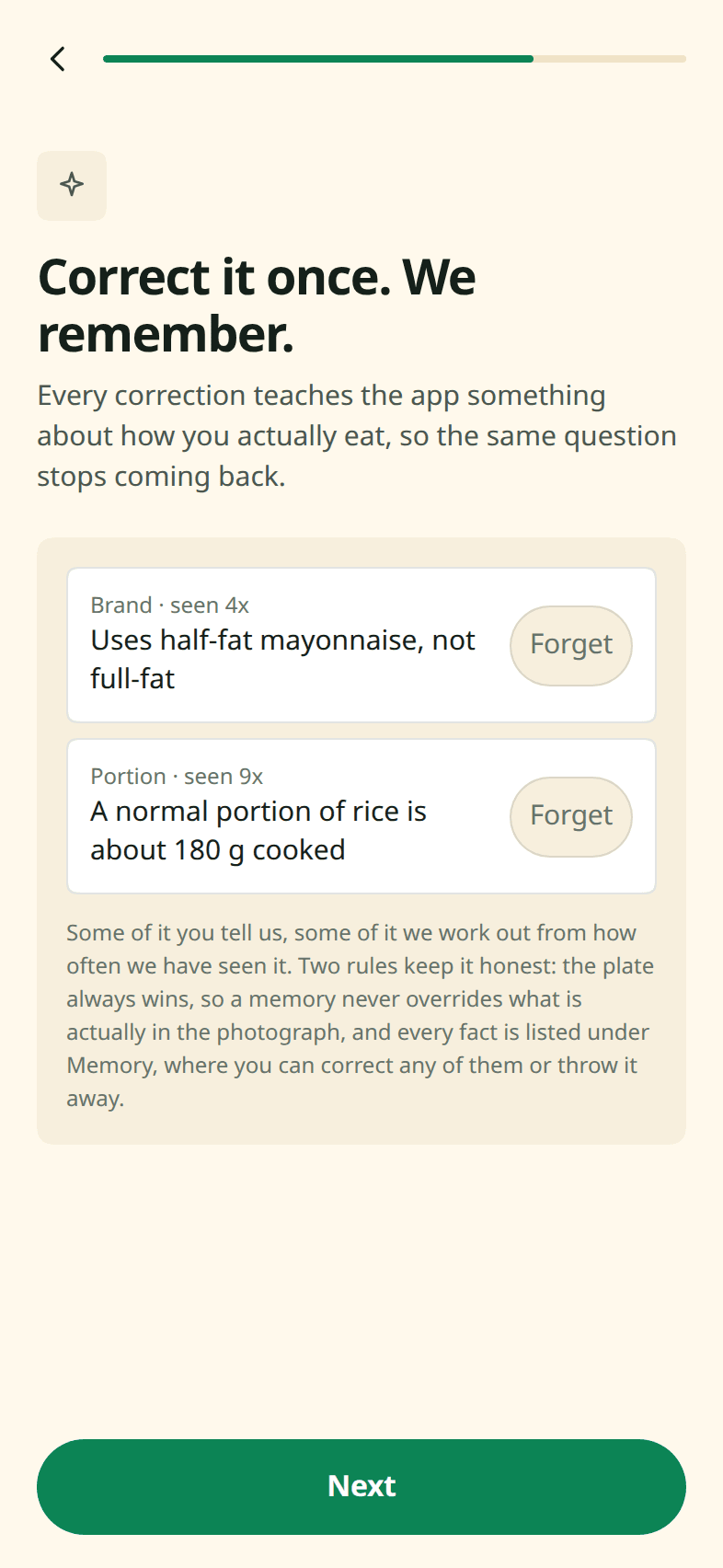
Week one it asks, because it has never met your kitchen. Every answer and every correction gets written down, in a sentence you can read and delete. A few weeks in, your usual food goes through in silence, and logging is a photo and nothing else.
A white tub in a bowl, and it genuinely cannot tell which one. So it asks, because the answer is worth fourteen grams of protein.
It reads back over the day while nobody is waiting, and writes down the one thing it learned. One sentence, in plain words.
Filed under what it knows about you. Delete it there if it is wrong.
Same tub, same bowl. No question this time.
Eats the 0% skyr, not yoghurt.
Tares the scale before every addition, so a reading is the thing just added, never the bowl.
Lands around 180 g, so a portion estimate starts there.
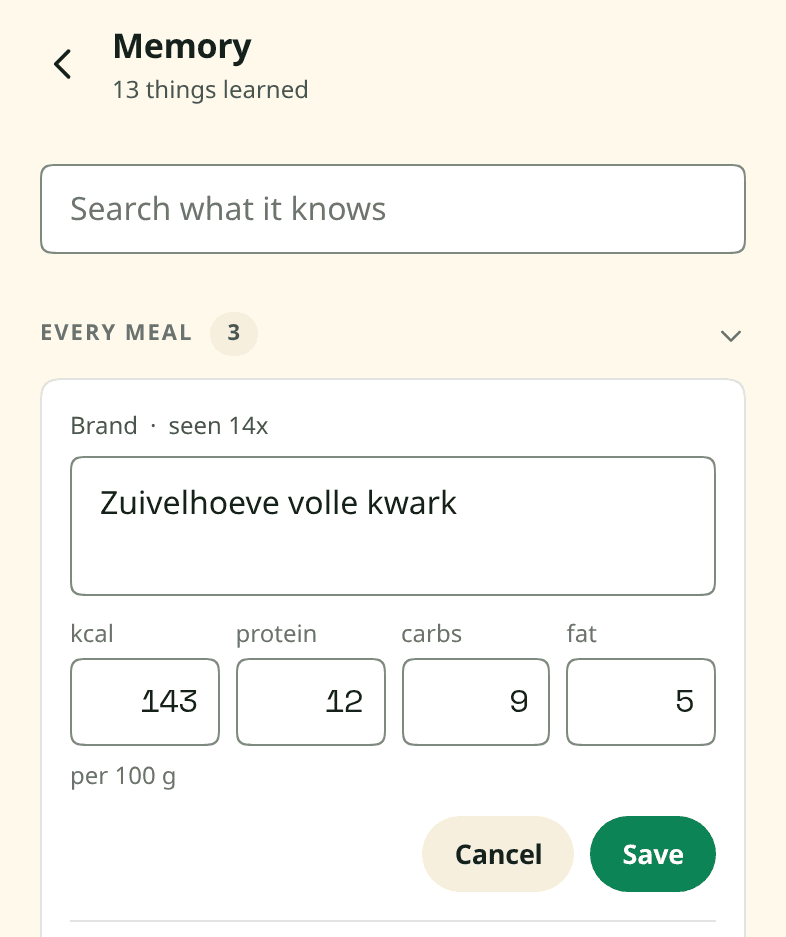
The jar was on the table once, label and all. 250 kcal per 100 g, carried to every slice since.
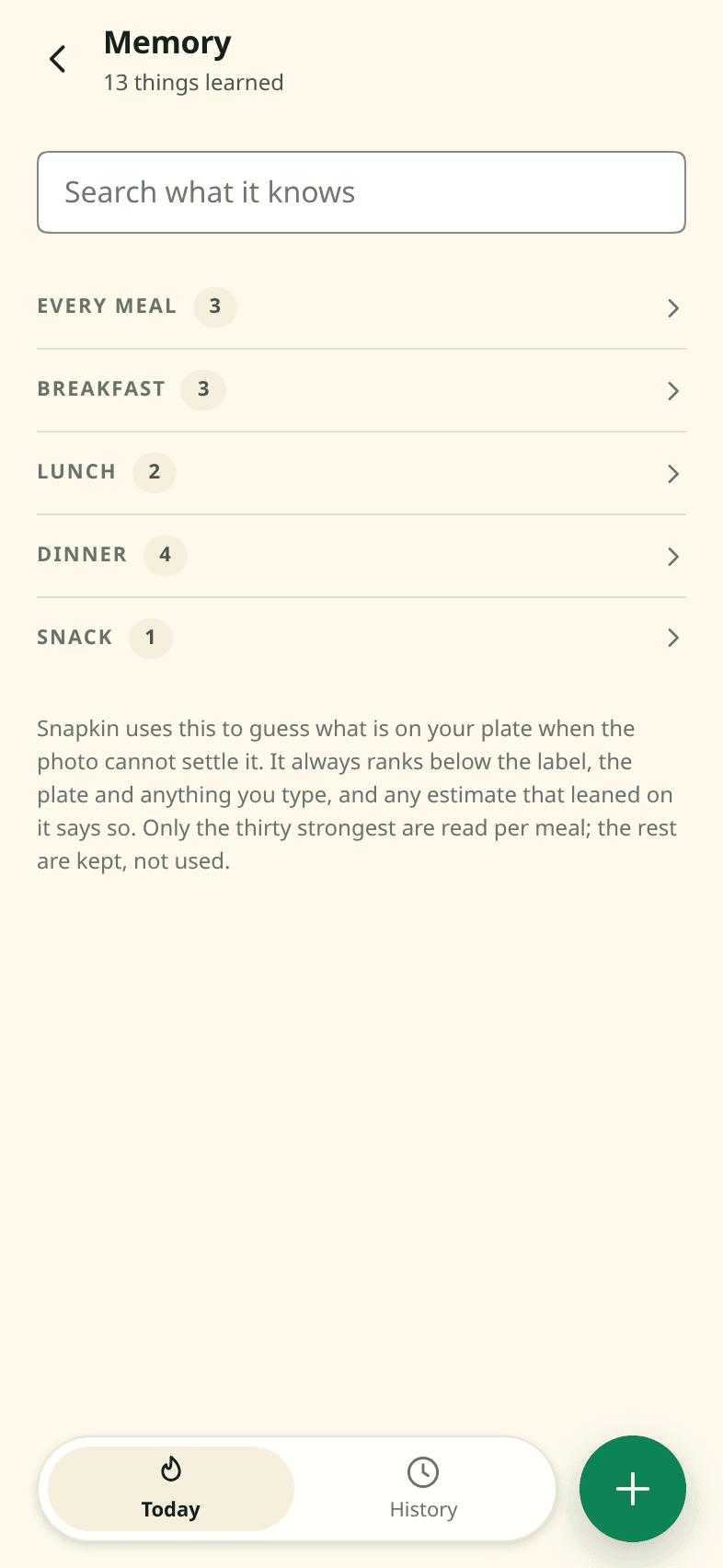
This screen is in the app. Nothing on it was typed into a settings form. It all came out of meals you photographed and things you said about them, and every line has a delete next to it.
It is a list of sentences, not a model of you
One of those you can open and read. The other you can only trust.
You can read every line.
"Eats the 0% skyr, not yoghurt." "Tares the scale before every addition." Plain sentences in the language you use the app in, not weights in a network nobody can inspect.
You can delete any of them.
One button per line. Delete it and the app goes back to asking. That is the right thing for it to do about something it got wrong.
You can see where each one came from.
Seen fourteen times, or told once. A habit it worked out from your meals and a fact you stated are two different kinds of confidence, and the list says so.
Nothing on it was typed into a settings form.
It all came out of meals you photographed and things you said about them. There is no preferences screen to fill in before the app is any good.
Some of it is about you, some of it is about breakfast
A brand off a label is true of every meal you eat it in. "The big bowl is the 400 ml one" is true of breakfast and nowhere else. So a fact carries a scope, and you can move it: every meal, or one meal of the day. The kinds that could not sensibly be narrowed, like a label it read, do not offer the choice.
A memory never overrules the plate
The failure mode of an app that learns you is an app that stops looking. This is the order it decides in, and it does not change.
- A label in the photo
- What is visibly on the plate
- What you typed on this meal
- What it remembers about you
And when it leans on a memory, it says so on the meal. The line names the assumption it used. So the one night you had the full-fat yoghurt is something you catch that evening, instead of an error that compounds for a month with nothing to show for it.
Tell it something once
That is the whole habit, and it survives restaurants, holidays and Thursdays, because there is nothing to keep up.
€14.99 a month or €99.99 a year, billed by the store, cancel there any time.